
How it’s Done(?)
Reflections on KPop Demon Hunters, queerness, and solidarity

I finally caved last week and watched the record-breaking Netflix movie KPop Demon Hunters. For those unfamiliar with the movie, it follows the story of a KPop band Huntrix, which is a cover for their actual calling: destroying demons through the power of song. Think of it as a take on Buffy, if Buffy was the lead singer of a pop band and music helped her keep the demons at bay. The music is incredibly catchy and the animation is amazing. It’s easy to see why it’s become such a global phenomenon.
I have to be honest. I have mixed feelings about the plot. It should go without saying that there are massive spoilers below, so consider this your warning.
A major plot point of the film is that the band is trying to create enough positive energy through their music to permanently seal the Honmoon, a mystical forcefield that will keep demons out of the human world forever. This is important because demons harvest human souls, so Huntrix’s sacred duty is to protect humanity from the threat.
What two of their trio don’t know, though, is that their lead singer Rumi is half demon. Her mother was a human and her father was a demon. She’s hidden it from her friends their whole lives. Much of the movie centers on her inner turmoil about hiding this from her friends and the hope that, once they close the Honmoon, her demon patterns (which she hides with her clothes) will disappear and she can have a “normal” life. The more shame she feels about her demon patterns, the more they grow.
As the movie progresses, she’s outed on stage by other demons. Her bandmates don’t know what to do and leave. Distraught, Rumi seeks out her adoptive mother (who had encouraged her to keep this secret from her friends) who immediately reminds her that sealing the Honmoon will “fix” Rumi. Rumi asks, “Why couldn’t you love me?” When her adoptive mother begins to say she does, Rumi shouts for clarification, “[Why couldn’t you love] all of me?”
She eventually reunites with her friends and they defeat the villainous Gwi-Ma by embracing the truth of who they are. The Honmoon is sealed and humans can live in peace. Rumi is at peace as well, as she no longer feels the need to hide her demon patterns.
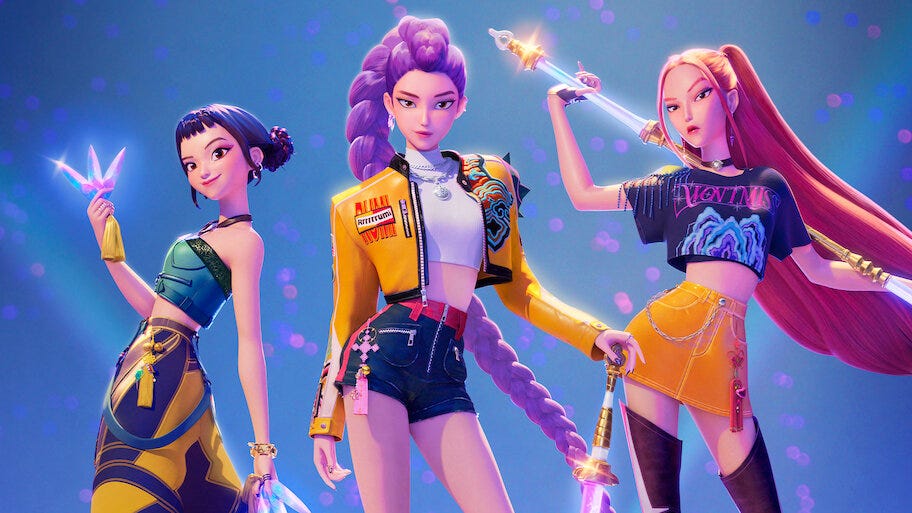
(Huntrix members left to right: Zoey, Rumi, Mira. Image copyright Netflix, Fair Use)
On the one hand, it’s a powerful metaphor for the pain and isolation a queer person feels when they are closeted. Many of us know the pain Rumi felt when her adoptive mother insisted that her difference was a problem to hide until it could be fixed. Seeing Rumi proudly show her demon marks at the end of the movie shows how she’s able to move to self-acceptance–perhaps even pride–in who she is.
But on the other hand, Rumi’s made a career out of killing demons. As she’s wrestling with her own struggles, she befriends the demon Jinu. He used to be human. He grew up living in intense poverty and sold his soul to Gwi-Ma so that he wouldn’t starve to death. The catch, though, is he betrayed his family to do it. He’s been a demon working for Gwi-Ma (who uses guilt and shame to control the demons) ever since.
Gwi-Ma rules the demon realm and forces demons to bring him the souls they harvest. In every clip the movie shows of the demon realm, it’s clear that the demons are scared of Gwi-Ma and would much rather not serve him. They do so out of fear, controlled by his knowledge of their deepest shames.
It makes me wonder about how the other demons got there. Had they all been faced with similar impossibilities like Jinu’s that led to their transformation? Were they all people who simply made a mistake? Did they really deserve to die?
More pressing, though, is the contradiction within Rumi. If she can see for herself that the demons aren’t necessarily bad (and knows for a fact that she’s a good person, demon and all), why does she continue to harm members of her own community? Perhaps it was easier for her to continue her work because the demons she fought no longer looked like her or Jinu. That is to say, they no longer looked human and therefore no longer looked “normal.”
In Rumi, I see the gays and lesbians who perform their queerness as closely as possible to the expectations of cisgender straight relationships. They cry to the straight people in places of power, “See, look! We’re just like you, only gay” so as to come off as less of a threat while climbing the social ladder. In the same breath, they advocate for the removal of rights for people whose queerness looks a little more queer: trans and nonbinary people most prominently.
I’m especially reminded of Pete Budijedge, who recently joined a growing number of Democrats in saying we need to focus less on “trans issues” to win elections. He has also voiced concerns about trans girls and women participating in sports activities that align with their gender identity. These words and actions make it clear that certain gays and lesbians seek to distance themselves from other parts of the queer community in order to hold onto their own rights. If they get to keep their rights, what does it matter that other queer people lose theirs, right?
I wish the movie had resulted in a transformation in all of Huntrix that allowed them to see the humanity in the demons. What might it have looked like for them—Huntrix and demons—to join forces and take down Gwi-Ma altogether? What might that have taught us about making sure we’re keeping our eyes on the actual villain, not the people in our own community whom he’s pitted us against? That’s the story the queer community needs right now.
Am I saying KPop Demon Hunter is a bad movie? No; I actually added a few of the songs from the soundtrack to my gym playlist and I will probably watch the film again. However, I think it offers us an opportunity for a timely, necessary conversation in the queer community about how we are going to show up for ALL of the queer community in this season of life. No rights for some of us without rights for all of us. Our love is bigger than that.